

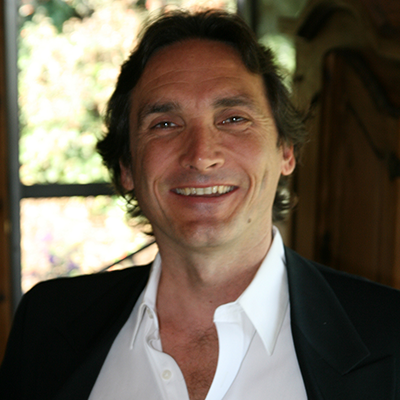
 Who I am, in plain words
I make technology actually do
what the marketing says it does.
That is the whole job.
I have been doing it for thirty years.
I join panels, lead mastermind rooms,
and give keynotes with live piano.
I am the idea person who can build the idea.
I have never had a job, and I am not a manager.
I code, I architect, and I design.
That is the whole method. Click a step for the talk.
I find where a system's promise and its behavior part ways.
Then I build the tool that works in that gap.
I describe what the code should do. The AI writes it.
I read it, and I fix it.
People should keep their own audience, data and voice.
And we should learn to measure real value.
I do not treat AI as an employee. It is a pattern synthesizer.
I talk about it that way, and it changes how people use it.
In 1994 I designed a messaging protocol in Perl. It took a year.
With Claude and our SDK, I believe the same design takes about a week.
That is the talk: a year, then a week.
I started in 6502 assembly, where every byte counts.
I still think in small pieces. It is why AI and I work well together.
I think everyone in tech needs to learn that role.
I want to teach it.
I wrote the book AI Assembly Language.
Read the three page version, in pictures.
I like a panel best.
A good question beats a prepared speech.
I bring a point of view,
and a real question for the person beside me.
My first choice.
I listen, ask, and say one thing worth keeping.
I lead a room of people with real work.
They leave with a system, not notes.
On request, with live solo piano if you like.
I would still rather end with a conversation.
Everything I build is a topic. Each talk has its own page and picture.
See all the talks, as a picture
Viktor Grant is Founder and CTO of Earthgrid, a search and member network built so people keep their own audience and their own data.
A technology optimizer for thirty years, he has built across five eras of computing, from Apple II copy protection to AI. He joins panels, leads mastermind groups, and plays solo piano.
Tell me the date, the room, and the question you want asked.
Every system has two versions of itself.
The one in the brochure, and the real one.
I live in the space between those two.
The marketing promise.
Clean, simple, and mostly true on stage.
The real behavior, under real load.
I test it myself before I believe it.
The tool that works in that gap.
Then I teach other people to use it.
That is the pattern behind every project I have shipped.
Earthgrid is the current expression of it.
It is not the first one.
Earthgrid is a mindset that became a company.
The project has been in motion since 2002.
The DNA goes back to the early 1990s.
I am not listing credentials here.
I am showing you one habit, repeated.
I wrote floppy disc copy protection in assembly.
I was a teenager on a three boy team.
Tiny memory. Tiny storage. No room for waste.
Optimizing against hard limits became my native language.
I read the official story about search ranking.
Then I tested it and found the gap.
I wrote a script that could tell
a human visitor from a robot.
It served each one the page it asked for.
I held all ten positions on a results page.
Three years of quiet work on one problem.
How do you know what a person wants next?
That architecture influenced a recommendation engine
a large online store later adopted.
The first Earthgrid was written in Perl.
The idea was a knowledge layer
underneath the global information network.
It grew into PHP, then Ajax, then Python.
Same thesis, better tools.
We streamed a full feature film online.
Web video was new, and we were learning it.
First I built Searchtriggers.
Autocomplete that helped people ask better questions.
That turned into the Earthgrid search engine.
We call it a find engine for a reason.
You find what you asked for.
Members keep their own listings current.
The listing is theirs, in their own words.
I have built on AI APIs since the first OpenAI Davinci models.
That is where Earthgrid.ai began.
Customers kept asking for more, so I wrote macros.
The macros grew into AI Assembly Language.
That language became Earthgrid.ai.
One instruction set that renders across models.
It is written to carry over to new ones.
Write once. Render on new models.
Your old work did not get worse. The models changed.
I am rewriting work from two years ago right now,
on models that did not exist when I wrote it.
Today I serve as Earthgrid's CTO.
I stepped back from running the company so I can build.
I am also opening up ideas I kept private for years.
I did not think people were ready for them.
I think the time has come.
One of my mentors put it simply.
I teach you what I do.
Then I do what I do.
So here is what I actually do, with receipts.
Most people do the opposite.
They type 100 words and want 2,000 back.
The result is often disappointing.
Flip it. Feed it more than you expect out.
The answers tend to improve.
I teach 5X. My own runs average 12.7 to 1.
Here is the receipt from my own account.
How to read an average. Total in over total out
is about 3.7 to 1, because a few runs
asked for whole chapters and code files.
Request by request, my typical run sits far above 5 to 1.
Always ask which average someone is quoting.
That biggest prompt was about 260,000 words.
Roughly three novels, in a single run.
AI does not improve by getting bigger. It improves when humans learn to use it properly.The Earthgrid thesis
That is what Earthgrid.ai is for.
It shows you what is behind the AI.
Use it regularly and the habit carries over.
Not just here. To any AI you use.
The habit that matters most is your own memory.
Write your context down, and hand it over as files.
I keep my notes in the open, in two files.
They are in the free handout below.
Insights Magazine ran a feature story on me
and on the work behind Earthgrid.
It is a long read
on how I think about all of this.
I write these for our members and give them away.
Sign in free and they open right here.
Both open in a new tab, after a free sign in.
Bob Heyman is known as the father of SEO.
He advises Earthgrid, and we are writing a book.
It is called GEO is the New SEO.
Two parents of one era, writing the next one.
Daniel Kottke co-founded Fastmovie.tv with me.
That is where the first film stream came from.
More of my writing lives at viktorgrant.com.
You can also find me on LinkedIn.
Please do not pitch me coaching there.
The piano, an anthill, and where I started
live on a quieter page. Musings, for the curious.
I find the gap. I build the tool.
Then I teach whoever shows up.
Tell me who you are and where you fit.
The quiz takes two minutes.