

Search used to mean a page of links.
Now AI reads the web and hands people one answer.
It decides who gets seen, who gets trusted,
and who gets left out.
Nobody asked your permission.
Viktor Grant · fractional CTOSearch meant a page of results.
A few SEO tricks moved you up the list.
AI systems decide visibility, trust and relevance.
They answer for people, and name who they trust.
People still search.
More and more, they ask an AI instead.
The AI reads everything it can find.
Then it writes one answer and names a few sources.
If your name is not in that answer,
the click never happens.
Your website ranked last year.
So you assume people can still find it.
AI leaves most businesses out of its answers,
unless someone shows it who they are.
An AI can only recommend
what it understands.
If your site is hard for a machine to read,
or never says clearly who you are,
the AI fills the gap with someone else.
Or it fills the gap with a guess.
Ask three different AIs about your business.
Use the words a customer would use.
Do they name you?
Do they get the facts right?
If not, you are invisible, or misquoted.
Both cost you customers.
AI decides how you appear online.
You find out after the damage is done.
You decide what AI knows about you,
once you know the method.
We built Earthgrid for one reason:
Humans should control how they appear in AI,
not the companies who own the AI.
Earthgrid gives you three things to do it.
Not by gaming algorithms.
By making the truth about you easy to find.
AI gives average answers,
because it reads everything.
Earthgrid teaches you
to make wrong answers unavailable.
I wrote a 100-page book
on why AI gives so-so answers.
And the simple habit that fixes it.
Join Earthgrid free,
and the 3-page summary is yours.
You did not make the machine smarter.AI Assembly Language · Chapter One
You made the wrong answers unavailable.
AI predicts the next most likely words.
Ask a short question,
and you get everyone's average answer.
Hand it good material first.
Most wrong answers become impossible.
That material is called context.
Early programmers built look-up tables.
Answers worked out ahead of time.
Looking up beat calculating from scratch.
Build your look-up table first.
Then the AI doesn't guess. It looks it up.
"Write a blog post
about starting a vegetable garden."
You get the post everyone gets.
Gather four trusted gardening sources.
Note your readers: retirees with raised beds.
Then ask.
You get your post.
We built the book's idea
right into our search.
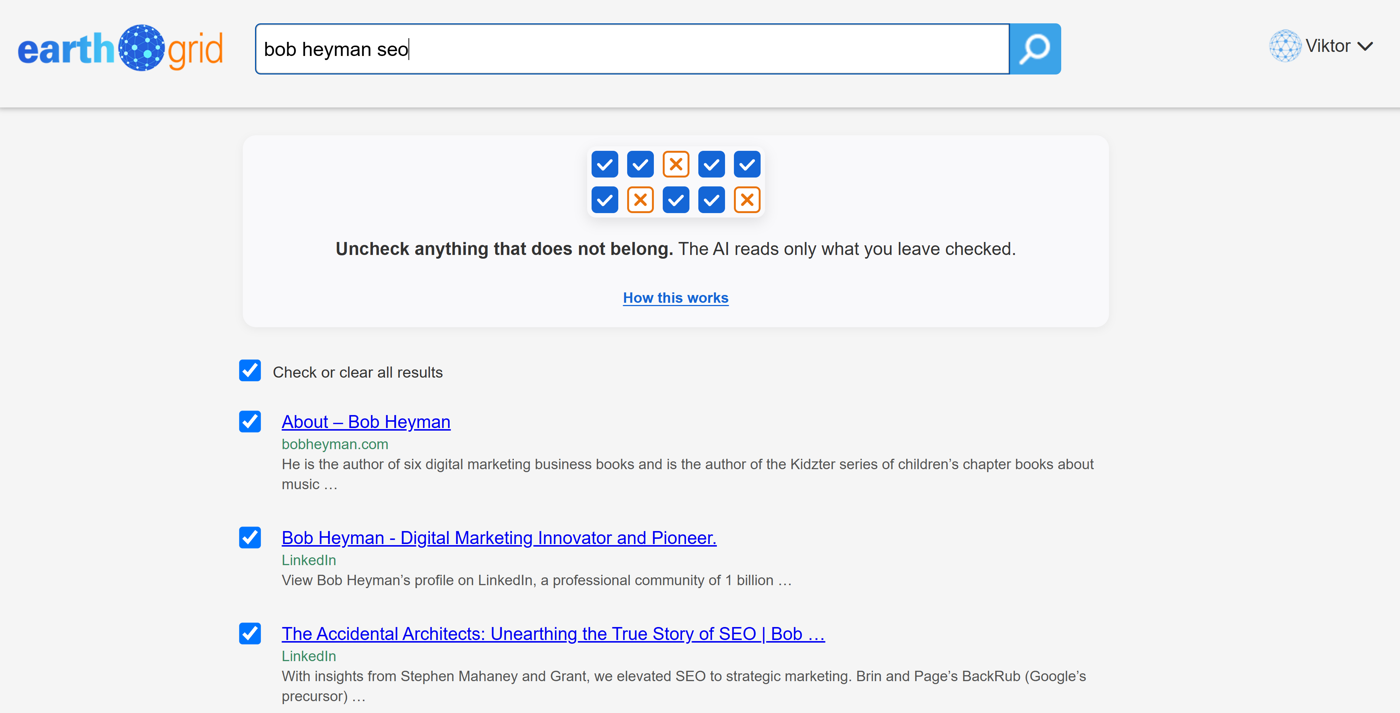
Search for Bob Heyman, a senior advisor
and partner-level member of our community.
He's often called the father of SEO.
You get 7 good results and 3 bad ones.
Uncheck the bad ones.
The AI reads only what you leave checked.
10 results checked.
3 of them don't belong.
Search the web through different eyes.
Keep the best of each. More engines coming.
Gather first. Ask last.
Visibility feels random,
and out of your control.
Earthgrid gives you a method
to stay findable in AI.
Use your email,
or sign in with a network you already use.
One login for the whole grid.
Meta's AI joins our engines soon, too.
Your work, your business, your ideas.
Visible in the age of AI.