

The man printing our T-shirts
asked me a fair question.
“What exactly do you do?”
Viktor Grant · fractional CTOFair question. Here is the honest answer.
You are trying to get found.
On Google, and now inside the AI answers
that are quietly replacing Google.
Most people get stuck in one of three places:
their SEO, their AI,
or the grey area in between,
where nobody can tell you what is working.
That grey area is where I live.
I started building this in 1997,
the year before Google.
I have watched the rules change twice.
Both times, a few gatekeepers decided who gets seen,
and good websites went quiet overnight.
So here is what we do.
We help you get found by the machines,
without handing your business to the people who own them.
And we do it together.
Nobody ever got past a gatekeeper alone.

I didn't set out to build Earthgrid.
I think I was handed the job.
Oregon Country Fair, 1989.
A strange man named Wayne Gaydos
was selling a gold-plated pyramid. I wasn't buying.
Then he looked me straight in the eye.
You. You're the Earthgrid engineer.
You were sent to this planet to build the global information network.Me: “Huh? What’s an Earthgrid?” Wayne Gaydos · Oregon Country Fair · 1989
That question has driven me ever since.
Open the chapters to follow the thread.
Nobody had a web browser yet.
A "global information network" sounded like science fiction.
But the phrase stuck. So did the pyramid.
Maps cut the planet into squares.
Rows and columns. Boxes to sort people into.
We use triangles instead.
It's the strongest shape in engineering.
A triangle stands only when all three sides
hold each other up. So does a network.
In 1994, Microsoft invited me to become an ICP on MSN, The Microsoft Network.
I produced live events with Jack Canfield and more than 50 best-selling authors. Our chat community grew to between 50,000 and 60,000 members.
Then something strange happened.
During live chats with 2,000 people online, their questions started matching the ones I was about to ask. It was as if we were all thinking together.
One of those interviews was with Peter Russell, author of The Global Brain. I was not just interviewing him about the idea. I was watching it happen in real time.
Connected people think better together.
That chat was true community. People helped each other,
and nobody was selling their attention.
I never forgot how it worked. Years later,
that memory let me rebuild it for Earthgrid.
Eight years after the fair, I founded Earthgrid.
It was never one website. It was three parts,
working together like a triangle.
Earthgrid.com: cloud computing and web design.
Earthgrid.net: free mini-sites and messaging for groups.
Earthgrid.org: resources for humanitarian work.
The mission still fits:
“We’re cleaning up the Web one Web site at a time.”
In 2003, we ran bulk text messaging
for a Hollywood Bowl event planning meeting.
The meeting was at a well-known
Italian restaurant in Santa Monica.
The keyword in the text?
“Free Food.”
That's why people came.
The right words move people.
By 2004, Earthgrid had its own messenger.
19,827 people signed up to write to each other on it.
Many of them are still out there.
We're inviting them back, one person at a time.
In 2011, the directory was busy.
233,505 clicks went through to member sites that year.
By 2014, 96.5% of that traffic was gone.
Nobody left. Nobody stopped caring.
The gates were still there. So were the guards.
But the guards had started deciding who got through.
In about three years, a whole generation
of good websites simply went quiet.
So we rebuilt the search around one idea:
no single company should decide what you see.
We draw results from Google and a dozen other sources.
We are not trying to beat any of them.
We just refuse to depend on one of them.
You choose. That was the whole point.
And it grew again, quietly, year after year.
Then the rules changed a second time.
The answers moved inside the machines.
People asked a question,
and something else answered for them.
Fewer and fewer clicked through to anyone.
Here is what the gatekeepers left us with.
70% of our original community's email
sits with just four companies.
Of the 19,827 people who built Earthgrid 1.0,
200 have found their way back so far.
That is about 1 in 99.
We did not lose them.
We lost the roads to them.
So what actually moves the people in charge?
Not asking nicely. Leverage.
They have to want what you have.
Scattered, a community has none.
A community that finds itself again has plenty.
That is why this is the age of disclosure.
Much of what we built stayed private for years,
because I did not think people were ready.
Now we are opening it up.
The global information network is real now,
and machines decide what people see on it.
So Wayne's question has a sharper edge:
Who is the network for?
Network health, counted every day · 67,283 valid members · 749 of 1,248 listed sites checked and still up · updated Oct 17, 2026 UTC
Every live number in this section is counted from our own database
once a day, and shown whether it flatters us or not.
That is what disclosure means.
Read more: my Insights Magazine interview (PDF) · About Viktor Grant
In 1994, chat on MSN was true community.
People helped each other. Nobody sold them anything.
I rebuilt that chat from memory.
It lives inside Earthgrid now, next to our own messenger.
Why build our own? Because our community
was taken from us once. Open the chapters.
An associate at the time asked me a simple question.
Why not build a search engine for current events?
Web pages keep old, finished events online
to look important. Dead pages pile up
because accumulation looks like authority.
The platforms play for authority. We play for optimization.
There is a deeper problem with that whole model.
They give you reach for free,
and the price is dependency.
Your audience becomes their audience.
One day you look up and you can't reach
your own customers without paying rent.
So we built it. You listed your site, like early Yahoo.
You listed your event, and when it was over,
it simply stopped showing up in search.
We had our own event search
before event platforms were a category,
and before everyone traded their audience away
for free traffic.
Some people listed their events. Not enough.
So we let members list their sites instead.
Member listings sit where other search engines put ads.
Our own natural language search ranks them.
It was built for a community of about 100,000,
not a crowd of billions. We reached that size.
Today it's one click. Log in on earthgrid.com,
open your account menu, and choose My Listings.
Every paying Earthgrid member was on Skype.
We were all connected, every day.
Then Skype became Microsoft Teams,
and people jumped ship. I went to LinkedIn.
Most went to Signal or Telegram.
Emails stopped arriving. We lost our ability
to talk with our own members.
We didn’t lose our members.
We lost the line to them.
I tell the whole story in my podcast.
Watch The System Is Broken.
A community has a size where it sustains itself.
If everyone chipped in a little,
we wouldn’t need outside funding or consulting.
Investors want their money back, and they want control.
We want sponsors and contributors instead.
Contribute first, then receive.
That’s the fair exchange everything here rests on.
So we’re checking every listing, and inviting
every listed member into the new messenger and chat.
Had an Earthgrid account years ago?
Talk to a human and we’ll reconnect you.
I once met Simon Sinek in New York.
His message: start with why.
People don't follow what you do.
They follow why you do it.
A client and mentor called me yesterday.
She wants me to tutor her in Earthgrid.
She'd heard tech leaders like Sam Altman and Elon Musk
warn that AI could destroy humanity.
I disagree. Pick a pill, and I'll tell you why.
Welcome to blue pill land.
Big search is the blue pill. Most AI is too.
Each shows you what its owners choose.
AI won't destroy humanity.
But the people steering it may control us.
Agents. Automation. Agendas.
One recommendation at a time.
You can still take the other pill.
Good choice. In The Matrix it was red.
Ours is orange.
Earthgrid is the antidote.
It doesn't try to control AI.
It educates humans.
Learn how search and AI decide who gets found.
Then take your place on your terms.
Your data is your most valuable asset.
Here, you control it. You're not the product.
Sinek draws circles. We draw a pyramid.
Tap each level.
Why: A network should serve its people,
not steer them.
Humans should understand the machine.
Not the other way around.
How: We educate instead of control.
You own your data and your listing.
AI helps you work. It never decides for you.
Every project starts from a solid framework.
What: Search you can list yourself in.
AI authority files. Servers. Community.
It's all in the menu above.
Take the tour.
Earthgrid began as three sites.
Then something happened we didn't see coming.
A fourth side appeared: EarthGrid.io.
Now the grid maps to the four ways
people earn: E, S, B and I.
And at the center sits the fifth element,
earthgrid.ai. That's our why.
The idea comes from Robert Kiyosaki's
Cashflow Quadrant.
Tap a letter, or the center.
I am its servant.
I work for planet Earth.
Search, listings, AI tools, servers
and your dashboard. It's all there.
67,283 valid members and counting.
Search without ad tracking.
List your site. Edit it anytime.
Help AI find, quote and verify you.
Get a server with everything installed.
A network of entrepreneurs.
Where independent builders connect,
share tools and lift each other up.
The global brain, rebuilt for today.
Investing in social capital.
Nonprofit and for-profit ventures
that create value beyond money.
This is where the fund begins.
See the fund.
Our first member venture project.
We didn't build it. A brilliant team did.
We're proud to have been there early.
EarthGrid.io is an infrastructure company.
Its plasma tunnel-boring technology cuts through rock.
Their mission, in their words:
“building the grid we deserve.”
We did their SEO.
We wrote and ran their press releases.
We helped them raise capital.
And we invested in them ourselves.
EarthGrid.io is our investment, and we believe in it.
They're playing the business game
at full scale. We're cheering them on.
This is our why.
I've been in a lot of masterminds.
I paid for every one of them.
So I set out to build one
that eclipses them all.
“The future belongs to those
who learn to lead AI, not follow it.”
A one-hour core training to start.
Six weekly live group sessions.
Every session recorded,
with lifetime replay access.
An e-book with the complete framework.
PRO-level Earthgrid access,
with the platform credits you need.
90 days of structured support.
The framework draws on 9,320+
production sessions with AI.
More than 22 million words of input.
Its core idea: AI doesn't think
the way humans do.
Learn how it does,
and you can direct it with precision.
Why all five?
Work, network, business and investment.
Each side holds the others up.
The center gives them a reason:
people who learn to lead AI together.
Four triangles form a tetrahedron,
the simplest structure in Fuller's synergetics.
New here? Every menu item has a reason.
Pick one to see why. Then go try it.
The industry says AI will write all the code.
I don't buy it. Code written without humans
really sucks.
Here's how I actually build with AI.
My lead developer asked me:
Screens, layouts and graphics.
First drafts. Repetitive code.
An idea you can see by the afternoon.
Decide what to build, and why.
Design the core system.
Set the guardrails. Review the work
before real people depend on it.
AI is only as good as its starting point.
That's why I wrote the ebook.
And why our developers write the rules.
Humans write the rules.
AI builds inside them.
The term artificial intelligence was coined in 1956.
It has always been a big field with many branches.
Somewhere along the way, two very different things
got thrown into the same box.
One is a language model: a tool you think with.
It answers. You decide.
The other is an autonomous machine
that makes decisions for you, like a car that drives itself.
They are not the same thing.
Mixing them up is how people
end up afraid of the wrong one.
The real risk is agents let loose
with no guardrails and no integrity built in.
That is why we need a community upgrade, not a panic.
My friends watch videos about AI swarms ending the world.
They ask me if I am worried.
No. Because I understand how this technology works.
I only work on things I can actually influence.
Not on the things I cannot.
I do not think AI is what destroys us.
Uneducated humans might be: people who wrap AI
in rules of control, then automate those rules
without understanding them.
Disaster rarely arrives as a villain.
It arrives as one small, careless choice.
Imagine a company leaves its entire backup
sitting in a public folder, where anyone could download it.
Nobody meant any harm. Nobody noticed.
That is exactly the problem.
Multiply that small mistake by a machine
that repeats it a million times a second.
We all get through this together,
or none of us do. The choice is ours,
and it is made in small moments like that one.
I wrote a 100-page book
on why AI gives so-so answers.
And the simple habit that fixes it.
Join Earthgrid free,
and the 3-page summary is yours.
You did not make the machine smarter.AI Assembly Language · Chapter One
You made the wrong answers unavailable.
AI predicts the next most likely words.
Ask a short question,
and you get everyone's average answer.
Hand it good material first.
Most wrong answers become impossible.
That material is called context.
Early programmers built look-up tables.
Answers worked out ahead of time.
Looking up beat calculating from scratch.
Build your look-up table first.
Then the AI doesn't guess. It looks it up.
"Write a blog post
about starting a vegetable garden."
You get the post everyone gets.
Gather four trusted gardening sources.
Note your readers: retirees with raised beds.
Then ask.
You get your post.
We built the book's idea
right into our search.
Search for Bob Heyman, a senior advisor
and partner-level member of our community.
He's often called the father of SEO.
You get 7 good results and 3 bad ones.
Uncheck the bad ones.
The AI reads only what you leave checked.
10 results checked.
3 of them don't belong.
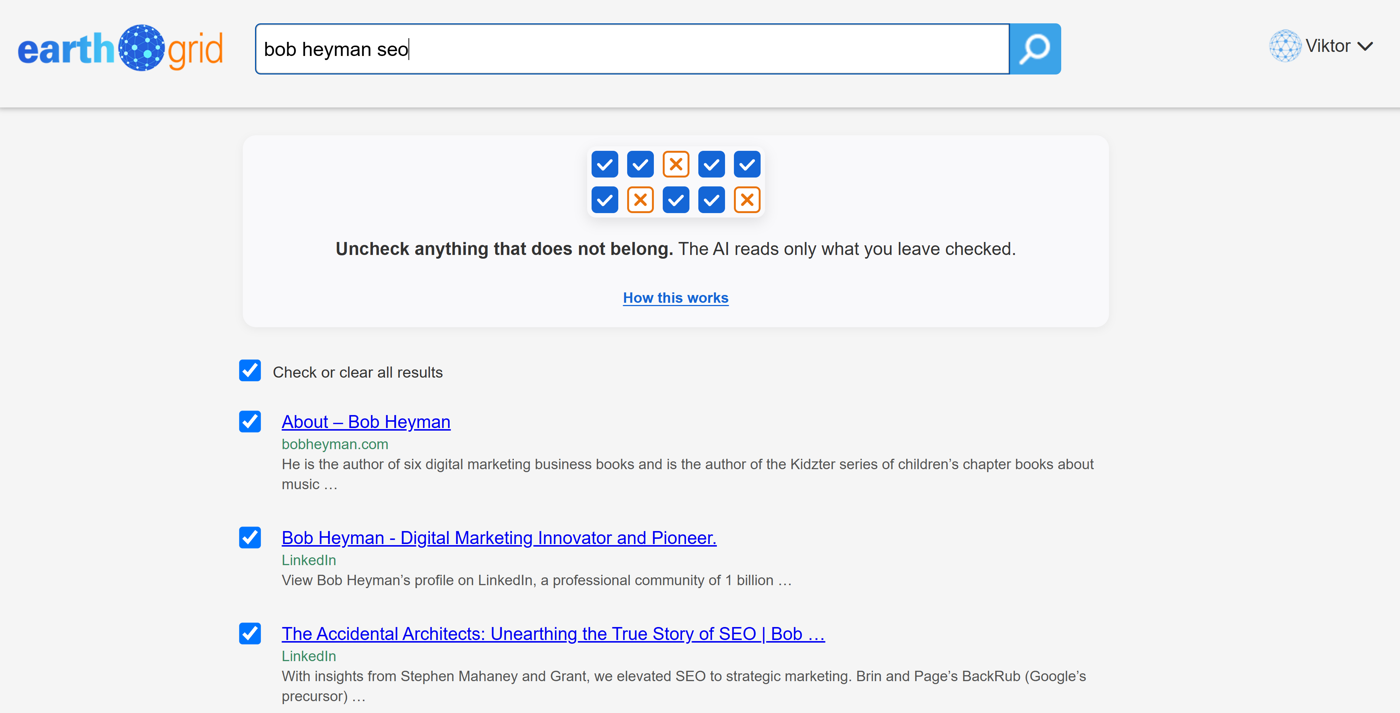
Search the web through different eyes.
Keep the best of each. More engines coming.
Gather first. Ask last.
Use your email,
or sign in with a network you already use.
One login for the whole grid.
Meta's AI joins our engines soon, too.
I'm a fractional CTO.
I work with tech companies, not for them.
That's how Earthgrid works too.
Today, Earthgrid is about our community.
We use Earthgrid to write business plans,
fund companies, and build our own venture fund.
The usual deal.
You give up control of your company.
In exchange, you get money.
And a board of directors
who tells you what to do.
All in the name of shareholder value.
Golden handcuffs. Work for the man.
Then, too often, lose everything.
Our deal.
You keep control of your company.
We put your money to work.
And a team of builders
who work for you.
All in the name of founder value.
No handcuffs. You stay the boss.
And you learn what you're really worth.
I know the blue pill version.
It happened to me.
It took me 90 days to raise my first $100,000
from the best people I could find.
The moment that check was written,
I lost control of my own startup.
The next $500,000 took five minutes of my time.
The hired management team romanced the investor.
Yachts. Fancy documents. Big slide decks.
And they told him our technology
could do things it could not do.
Not out of malice.
They didn't understand it.
And they didn't care to.
The investor understood it.
He said: you are not the guys who built this.
I want to talk to the brains behind it.
So I told him the truth.
No, it doesn't do that.
It does this today.
In six months, with your investment,
it will do that.
He invested.
That's what a fractional CTO is for.
Seeing through the hype.
Knowing what the tech actually does,
and what it can honestly become.
In the age of AI,
we need that more than ever.
I know how to play the old game.
I refuse to play it.
That's why I teamed up with Burke.
Not as owners. As equals who help each other.
Burke founded JIAN, now Business Power Tools,
back in 1988.
He created BizPlanBuilder,
business planning software.
He wrote Business Black Belt,
real-world lessons for conscious capitalists.
He's also a second-degree black belt
in TaeKwonDo.
Business plans are where funding starts.
Burke has been writing that playbook for decades.
Earthgrid runs on phones.
But it was designed tablet first.
Then computers.
Because the grid needs room to work.
Ask a question. Read an answer.
A phone is fine for that.
Search. Choose. Stack. Build.
You need space to move,
to tap, to click, to interact.
That's the Earthgrid model.
Tap a device to see how it runs Earthgrid.
Phone: it works.
Great for consumer AI.
Quick questions, quick answers.
But operating AI on a tiny screen
means pinching, scrolling and missing things.
Tablet: what we designed for.
I just bought a 2020 iPad Pro for $300.
It runs Earthgrid just fine.
You can find a tablet at Best Buy
for about $100 that runs it, too.
Room to tap, check and compare.
No desk required.
Computer: the operator's cockpit.
I run Earthgrid on three monitors.
Two are 4K.
One is a curved widescreen.
That's the right environment
for community and for Earthgrid.
You don't need an expensive setup.
A $100 tablet gets you on the grid.
A bigger screen gets you further.
It took me thirty-some years to answer Wayne.
An Earthgrid is an information network
built for the humans in it.
You're already standing on it.
Take the orange pill.
Not sure where you fit?
Seven questions. Two minutes.